
Broken Garage Door Spring Repair in Killeen, TX
Garage door springs wear out faster in Central Texas heat. Many homeowners in Killeen notice problems after the door suddenly feels heavy or stops lifting evenly. A damaged spring places pressure on the opener, cables, rollers, and track system. We repair broken garage door springs for homes across Killeen near Trimmier Road, Bunny Trail, Stagecoach Road, and neighborhoods around Fort Cavazos.
100+ ReviewS
Licensed & Certified
100% Satisfied clients
Why Springs Matter in a Garage Door System
Garage door springs handle most of the door’s lifting force during operation. A standard residential garage door can weigh several hundred pounds, but the spring system allows the door to open smoothly with controlled movement. When spring tension weakens, the opener begins carrying more weight than it should, which creates strain across the entire system. Many homeowners near Yowell Ranch, White Rock Estates, and neighborhoods around Stan Schlueter Loop notice early signs before complete spring failure occurs. The garage door may shake during movement, close unevenly, or create louder vibration than normal. These problems often appear weeks before the spring finally breaks.
Two Key Types of Garage Door Springs Used in Killeen
Understanding which spring type your door uses affects the repair cost and the replacement options. Here is how to tell them apart.
Torsion Springs
Torsion springs sit on a horizontal shaft above the door opening, mounted to a metal plate called a header bracket. They work by twisting and storing rotational energy as the door closes, then releasing that energy to assist the opener when the door opens.
Most modern homes in Killeen, built in the last 20 years, use torsion spring systems. They are more durable, safer when they break, and better suited to heavier doors. A single torsion spring handles smaller doors. A double torsion spring setup handles heavier or wider doors, which are common on two-car garages along the neighborhoods near Fort Cavazos and Trimmier Road. The average torsion spring lasts 10,000 cycles. With typical use of two open and close cycles per day, that works out to roughly seven to ten years.
Extension Springs
Extension springs run horizontally above the upper tracks on each side of the door. They stretch and contract as the door moves, using tension rather than torsion to counterbalance the door’s weight. They are more common on older single-car garage doors.
Extension springs are more likely to snap outward when they break, which is why they should always have safety cables threaded through them. If your door has extension springs without safety cables, that is a hazard we flag and correct during every replacement.
Which Type Do You Have?
Stand inside your garage and look above the door. One long spring centered above the door on a metal shaft — torsion system. Two springs running along the sides above the horizontal tracks — extension system. Not sure — tell us when you call, and we will confirm during the diagnostic.
Who Do We Help?
- Homeowners whose door stopped working this morning
- Military families during PCS season
- Spouses managing the home during deployment
- Homeowners who heard warning signs but have not broken down yet
- Landlords and property managers in Bell County
- New construction homeowners in Nolanville and Harker Heights
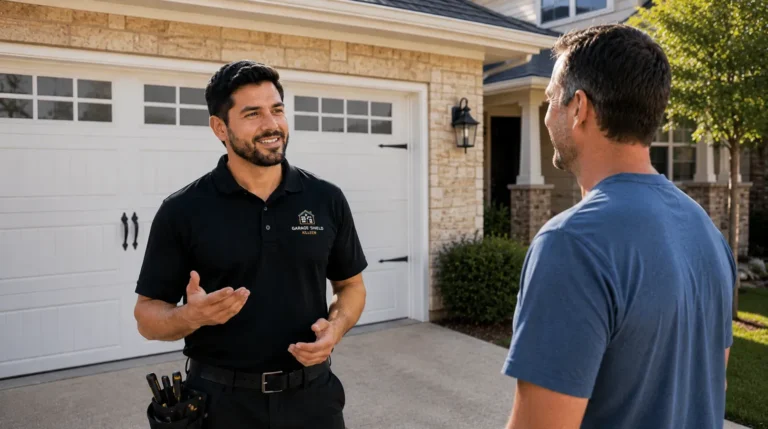
The Killeen Problem – Why the Garage Door Spring Broke?
Garage door springs in Killeen deal with environmental stress throughout the year. Garages near Clear Creek Road, Elms Road, and neighborhoods with direct afternoon sunlight often trap extreme heat during the summer months. Constant metal expansion and contraction weakens the spring material over time and reduces its lifespan.
Frequent daily use also increases wear quickly. Many homes near Fort Cavazos operate garage doors multiple times every day because of changing work schedules, school traffic, and daily commuting. Higher cycle counts create faster tension loss inside the spring system. Homes with double garage doors or insulated doors may also place additional weight demands on the springs.
How Do You Know Your Spring Is Broken?
Most homeowners know something is wrong before they know what it is. Here are the signs that point directly to a spring failure.
You Heard a Loud Bang From the Garage
This is the most common first sign. A snapping torsion spring releases stored energy instantly. The sound is sharp and loud, like a gunshot or a heavy object falling. It usually happens overnight or early in the morning when temperatures drop. If you heard that sound and your door stopped working, the spring broke.
The Door Won’t Open More Than a Few Inches
You hit the button. The opener runs. The door lifts two or three inches and stops, or it does not move at all. The motor is working but it cannot carry the full weight of the door without the spring doing its share. Do not keep running the opener. You will burn out the motor.
The Door Looks Uneven or Hangs Crooked
If one side of the door sits lower than the other, a spring on that side failed. Double-spring systems can lose one spring while the other holds, leaving the door tilted. Operating it in this state puts extreme lateral stress on the track and cables.
You Can See a Gap in the Spring
Look at the horizontal metal shaft above the door. The spring wraps around it. If you see a gap, a space where the coils separate, the spring broke at that point. It will not self-repair. It needs to be replaced.
The Cable on One Side Is Loose or Coiled on the Ground
When a spring breaks, the cable it controls goes slack. You may see the cable hanging loose along the side of the door or coiled on the floor of the garage. A loose cable means the door is no longer supported on that side.
Our Proven 4-Step Garage Door Broken Spring Repair Process in Killeen
1. Full System Inspection Before Any Work Starts
We do not just replace the broken spring and leave. A spring does not break in isolation. When one component fails, it puts additional stress on everything connected to it. Before we quote the replacement, we inspect the cables, drums, rollers, track, and opener. If the cable frayed when the spring broke, we tell you. If the rollers are worn and close to failing, we tell you. You make the call on what gets fixed.
2. Correct Sizing for Your Door
We measure the door’s height, width, and weight. We measure the existing spring’s wire diameter, inside diameter, and length. We check the winding direction. All of this determines the correct replacement spring specification. An incorrectly sized spring is not just ineffective — it shortens the lifespan of your entire door system.
3. We Replace Both Springs
If your door uses a double spring system and one spring breaks, we recommend replacing both. Here is why. Springs are sold and installed in matched pairs. They age at the same rate. If one broke, the other is close behind. Replacing both at the same time costs less than two separate service calls six months apart, and it keeps the door balanced.
4. Testing Before We Leave
After installation, we test the door balance manually. A properly balanced door should stay in place when lifted halfway and released. It should not drift up or fall down. We run the door through multiple open and closed cycles with the opener. We check the opener’s force settings. We test the safety sensors. You watch it work before we pack up.
What We Use — Parts Built for Central Texas
Not all springs are the same. Killeen’s climate puts specific demands on garage door hardware that builder-grade components are not designed to handle.
Oil-Tempered Torsion Springs
We use oil-tempered springs rated for 10,000 or more cycles as a standard. Oil tempering is a heat treatment process that increases the spring’s resistance to fatigue and corrosion. In a climate where garage interiors regularly reach 130 to 140 degrees Fahrenheit during Killeen summers, and drop to freezing in January, that metallurgical difference matters. Cheaper galvanized springs lose cycle life faster under thermal stress.
Galvanized Springs for Humid Environments
For doors in areas with higher humidity exposure, such as properties near low-lying areas around Killeen that collect moisture after heavy rain, we use galvanized springs with additional corrosion protection. Rust is the primary enemy of spring longevity in Central Texas. A rusted spring loses both strength and cycle life faster than the manufacturer’s rating.
Safety Cables on All Extension Spring Systems
Every extension spring replacement we do includes safety cables if they are not already present. Safety cables thread through the center of the extension spring. If the spring breaks, the cable contains it. Without a safety cable, a snapped extension spring can fly across the garage at high speed.
Pricing & Transparency
| Service | Price Range | Notes |
|---|---|---|
| Single torsion spring replacement | $150 – $225 | Standard residential door |
| Double torsion spring replacement | $200 – $350 | Recommended when one breaks |
| Extension spring replacement (pair) | $100 – $200 | Both sides replaced together |
| Spring replacement with cable repair | $200 – $400 | Common when cable goes slack |
| Spring replacement with roller upgrade | $250 – $425 | Nylon rollers, quieter operation |
| Emergency after-hours spring repair | $300 – $500 | Evenings and weekends |
Labor makes up about 60% of the total cost of a standard spring replacement. The spring itself is the remainder. Anyone quoting $49 or $69 on the phone has not accounted for labor, and the real number appears after they arrive. We give you the exact price before we start. The number you approve is the number on the invoice.
Should You Replace One Spring or Both?
On a double spring system, always both. The cost difference between replacing one spring now and both springs now is small. The cost of a second service call in three to six months when the second spring break is not. On a single spring system, one spring is the entire system. Replace it with the highest cycle rating available for the best long-term value.
Before and After — Real Spring Repairs in Bell County
These are actual jobs. Real doors, real failures, real outcomes.
Torsion Spring Failure — Trimmier Estates
Homeowner heard a loud bang from the garage at 5:45am. Door would not open past four inches. Opener was running but straining hard. Visible gap in the torsion spring above the door. Car inside, needed to leave for work by 7am. Both torsion springs replaced with oil-tempered units rated for 10,000 cycles. Cable tension checked, drums inspected, opener force recalibrated. Door balanced and tested through five full cycles. Homeowner left for work on time. Total time on site: 55 minutes.
Extension Spring Snap — Near Rancier Avenue
Single-car garage on a 1990s home. One extension spring snapped and hung loose above the track. No safety cable on either spring — a hazard the homeowner did not know about. Door manually locked closed. Car stuck inside. Both extension springs were replaced as a matched pair. Safety cables installed through each spring. Track alignment checked. Door tested for even travel and auto-reverse. Vehicle access was restored within 90 minutes of the call.
Spring Losing Tension — Yowell Ranch New Construction
Two-year-old home with builder-installed springs. The door had been moving slowly for two months and felt heavier than usual when lifted by hand. No snap, no loud noise — just a gradual decline that the homeowner almost ignored. Both torsion springs were found under-torqued at installation. Rewound to correct the specification for the door’s measured weight. Opener force settings reset. The door lifts freely, and the opener load is reduced. The homeowner avoided a full emergency by catching the warning signs early.
Signs You Need Spring Replacement Soon — Even If It Has Not Broken Yet
Most springs give warning signs before they snap. Catching them early means you schedule the repair on your terms, not at 6 am with your car trapped inside.
Disconnect the opener by pulling the emergency release cord. Try lifting the door manually to about waist height and let go. A properly tensioned spring holds the door in place — it should feel almost weightless and stay where you put it. If it feels heavy and drops back down, the spring tension is low. This is one of the clearest signs the spring needs attention before it fails completely.
Surface rust on a torsion spring is the first warning. Deep pitting follows. A spring with visible rust along the coils in Killeen’s climate — where post-storm humidity spikes accelerate corrosion — is shortening its own lifespan every day. Rust reduces both the strength and the cycle rating of the metal. A rusty spring is not just cosmetic. It is structurally compromised.
Run your eye along the spring coils. Smooth, consistent coil spacing is normal. Cracks, rough patches, or areas where the metal looks different from the rest are signs of metal fatigue. This is the stage just before a break. Do not wait for the bang. Schedule the replacement now and avoid the emergency call.
If the door used to snap open in a few seconds and now crawls or hesitates on the way up, the spring is losing tension. It is no longer providing its full share of lift. The opener is compensating by working harder, which shortens the opener’s life at the same time. A spring losing tension is a spring approaching failure.
A dry or corroding spring makes noise during operation. The sound comes from the coils rubbing against each other as tension releases and loads during each cycle. In some cases, a silicone spray fixes it. In others, the noise is the spring telling you the metal is fatigued and the end of its service life is close. We can tell the difference during an inspection.
Surface rust on a torsion spring is the first warning. Deep pitting follows. A spring with visible rust along the coils in Killeen’s climate — where post-storm humidity spikes accelerate corrosion — is shortening its own lifespan every day. Rust reduces both the strength and the cycle rating of the metal. A rusty spring is not just cosmetic. It is structurally compromised.
If the door looks slightly tilted when closed — one corner lower than the other — one spring may be losing tension faster than its pair. On a double spring system, uneven tension throws the whole door out of balance. The opener, cables, and rollers all take extra stress when the door is not running level.
How Long Will the New Spring Last?
The answer depends on three things: the cycle rating of the spring, how often the door is used, and whether the door system is maintained. A spring rated for 10,000 cycles on a door opened twice a day lasts approximately 13 years. The same spring on a door opened five or six times a day — common in households with multiple drivers or teenagers — lasts closer to five years.
Central Texas heat accelerates fatigue. Killeen garage interiors in July regularly exceed 120 degrees Fahrenheit. Metal fatigue increases at high temperatures, especially through repeated heating and cooling cycles. A spring that might last 12 years in a moderate climate may last 8 to 10 years in this environment without regular maintenance. Lubricating the spring every six months with a silicone-based spray extends its life significantly. This is one of the things we show you before we leave.
How We Handle Spring Replacement in Killeen
1. Full System Inspection Before Any Work Starts
We do not just replace the broken spring and leave. A spring does not break in isolation. When one component fails, it puts additional stress on everything connected to it. Before we quote the replacement, we inspect the cables, drums, rollers, track, and opener. If the cable frayed when the spring broke, we tell you. If the rollers are worn and close to failing, we tell you. You make the call on what gets fixed.
2. Correct Sizing for Your Door
We measure the door’s height, width, and weight. We measure the existing spring’s wire diameter, inside diameter, and length. We check the winding direction. All of this determines the correct replacement spring specification. An incorrectly sized spring is not just ineffective — it shortens the lifespan of your entire door system.
3. We Replace Both Springs
If your door uses a double spring system and one spring breaks, we recommend replacing both. Here is why. Springs are sold and installed in matched pairs. They age at the same rate. If one broke, the other is close behind. Replacing both at the same time costs less than two separate service calls six months apart, and it keeps the door balanced.
4. Testing Before We Leave
After installation, we test the door balance manually. A properly balanced door should stay in place when lifted halfway and released. It should not drift up or fall down. We run the door through multiple open and closed cycles with the opener. We check the opener’s force settings. We test the safety sensors. You watch it work before we pack up.
How long does a spring replacement take?
Most spring replacements are complete in 45 minutes to 90 minutes from arrival. That includes the full inspection, sizing, replacement, and testing. If we find additional issues like a damaged cable or worn rollers, the job may run longer. We tell you before we start what is involved.
Ready to Fix Your Spring? Call Now
A broken spring does not get better on its own, and the door is not safe to operate without it. The repair is one of the most common jobs we do. It takes less than two hours in most cases, and the door works correctly when we leave. Call us now. Tell us what happened and where you are. We will confirm availability and give you a time window. Same-day appointments available in Killeen and all of Bell County. Free estimate before any work begins. Written warranty on every spring replacement.
Got Questions?
We’re happy to help. If you can’t find the info you’re looking for, please don’t hesitate to reach out to us!
Call us (254) 358-2799